Tag Archive: do it yourself


A couple of months ago I had the good fortune to meet someone who is an avid hunter and fisherman, quite a good one too. And to top it off someone who has the same mindset of being able to survive come what may.
Having personally grown up in a family that hunted and fished out in the Midwest, as a child I can remember eating wild game, fish and fresh homegrown fruits and vegetables, some of it collected wild.
Well, you know how life goes, you grow up, move to the city and start to forget things…at least I did until the economic crash a few years back and moving to an area that is hurricane prone. Then I discovered the ‘prepping’ movement and down the rabbit hole I went, coming back around full circle to where I started from….but this isn’t a how to get back to basics blog or how to become more self-sufficient, rather, I would like to share a YouTube video done by VaCreepinOutdoors on how to use the should roast from a deer. People think that wild game is an acquired taste and that only certain parts of deer are ‘good’, but honestly, almost every part of any animal has its uses and most can be eaten if properly prepared and this video will show you how to cook that funny thing called a deer shoulder roast that most would throw away…enjoy the video!

Recipe:

1 Deer Shoulder Roast
Vegetables of Choice
Seasonings of Choice
Crock Pot

Marinate deer shoulder roast in olive oil and seasonings for 2 days in plastic baggie in refrigerator.
When ready to cook prepare vegetables as you wish, place deer shoulder roast in crock pot, place vegetables in crock pot, season to your own taste, basil, Italian seasonings are great seasonings for deer meat.

Place crock pot on low and walk away…will take approximately 6-8 hours on low…

It is absolutely delicious! Trust me, almost like eating roast beef, so this coming hunting season, don’t let that scary looking deer shoulder roast go to waste…its good eating.

Dehydrating Tomatoes!

Dehydrating Tomatoes

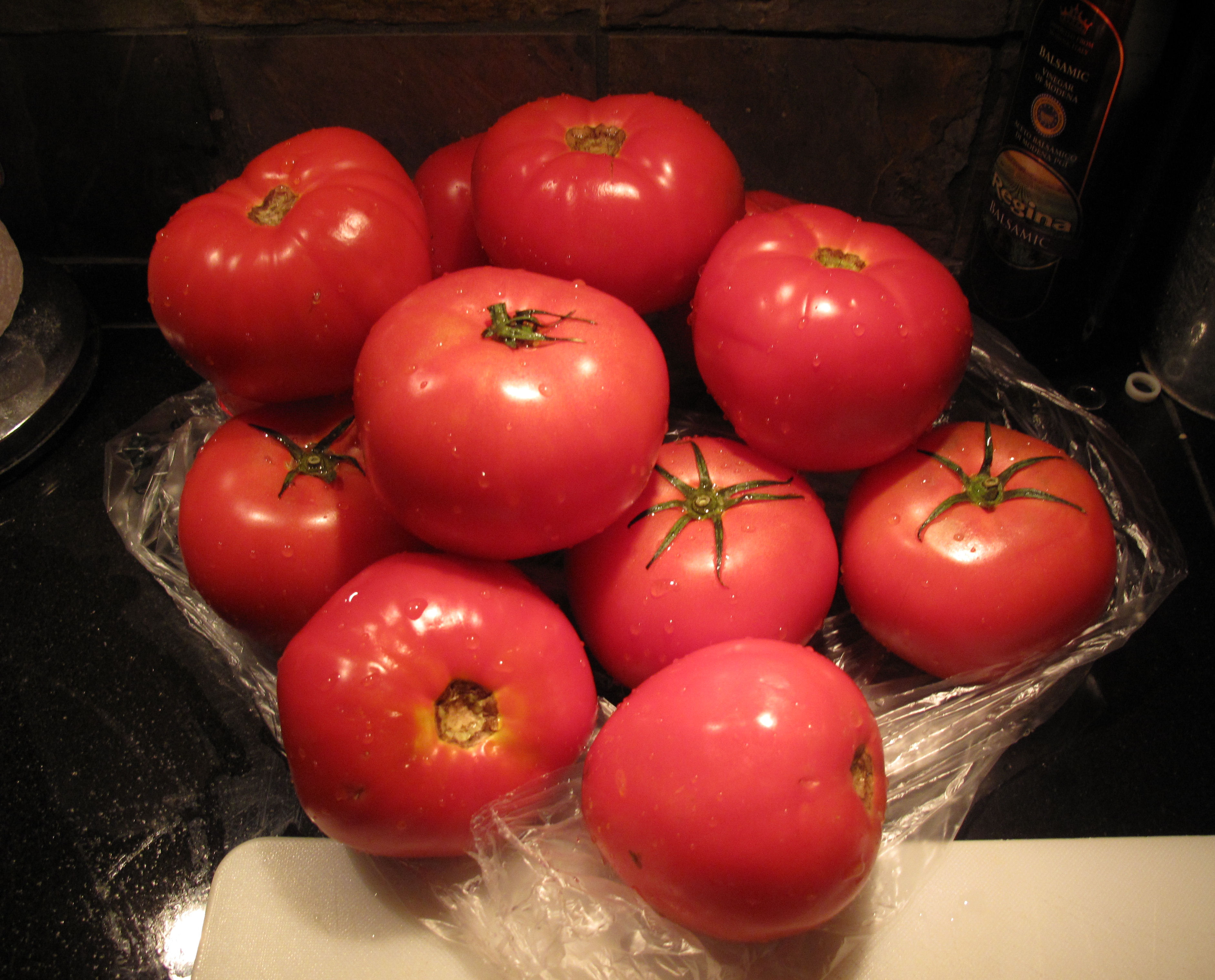
This is the year that I decided to become ambitious in my gardening, well, new raised beds were built, great soil mix put in, plants carefully selected (will say that after a disastrous year previously with heirlooms I went half with hybrids and half heirlooms) and put into the ground. But that is another story for another time. Last year was extremely hot and dry, bad crops…this year we were blessed with too much rain and cooler temps. My mother had mixed results with her tomotoes but she planted about 12 of them and its just her eating them, so she has some for dehydrating. Me, I only planted 4 and they took off great, then the rain came and came some more…got one good round of smaller tomatos which took forever to ripen and now the plants look like drowned cats…seriously, but that story and some ideas are for another post. I only mention this because I broke down and went to the store looking for some decent deals on tomatoes for dehydrating for use this winter. Got lucky and found different ones for between .99 and 1.39 a pound (yes, that much even though I live in the heart of tomato country the rain has caused massive crop failure of a lot of plants). So biting the bullet I purchased about 11 lbs of tomatoes, average cost of about 1.05 a pound.

In years past I have thinly sliced my tomatoes and then placed them on racks (I had an old round dehydrator that was labor intensive and not very good) stacked 5 high and plugged in to let it work. It was constant checking, moving tomato slices or chunks around, they stuck, broke…lets just say it was a nightmare and not fun at all. Some burned, some fell to pieces…arghh…what is the point in dehydrating if you have to do so much work and still wind up with something that is not good? Cheap is not necessarily the best way to go…so last summer at the end of the summer I broke down and purchased an Excalibur Food Dehydrator. Did my research on which one to get as some are really fancy and large and others are very plain jane. I settled on one with temperature control (mostly due to the fact that the little cheap round dehydrators dry at one temp causing more work than I wanted to put in) and 5 racks. More research into this I also purchased some solid drying sheets and while not the ones that Excalibur makes (thin silicone that supposedly lasts for ever but apparently don’t and are hard to clean, etc.) but an off brand that is much cheaper…harder to wash without crimping the sheet, but cheap…Made all sorts of things last fall including fruit roll ups that lasted about two seconds in my house. I was very happy with the purchase and Excalibur lives up to its reputation, so if you can, do get one, and no, Excalibur is NOT paying me, I just like it for its ease of use, clean up and the fact that I can easily control the temperature with ease. Cut, place and walk away basically…

This year I decided to try something different with the tomatoes on the advice of my mother who has dehydrated for years…first off, to prevent your tomatoes from sticking (and they will!) lightly spray or coat your racks with olive oil or something other oil that will not go rancid in a high temperature setting for a short period of time…olive oil is your best bet. And YES, I know ‘they say’ not to use ‘fats’ when dehydrating because they go rancid or someother goobly gook…I will put it this way to you, I know quite a few people who have dehydrated in my family and NO ONE HAS HAD AN ISSUE with using oil on their sheets or trays to date and my family has been dehydrating and preserving for generations. My own ‘need’ to ‘follow the rules’ resulted in a lot of wasted time, effort and energy, so, BREAK THE RULES!!!

Get your tomatoes ready by thoroughly cleaning them and then slicing THICK…about ½ inch thick. Now what size or shape you choose to finish cutting them up…sliced, diced…your choice, I chose to ‘dice’ them in about 1 inch chunks or so since my primary purpose will be adding to soups and such later on. Dehydrated sliced tomatoes would be best suited to casseroles, pizza or eaten like ‘tomato candy’ (dried tomatoes are VERY SWEET).

20130807_5

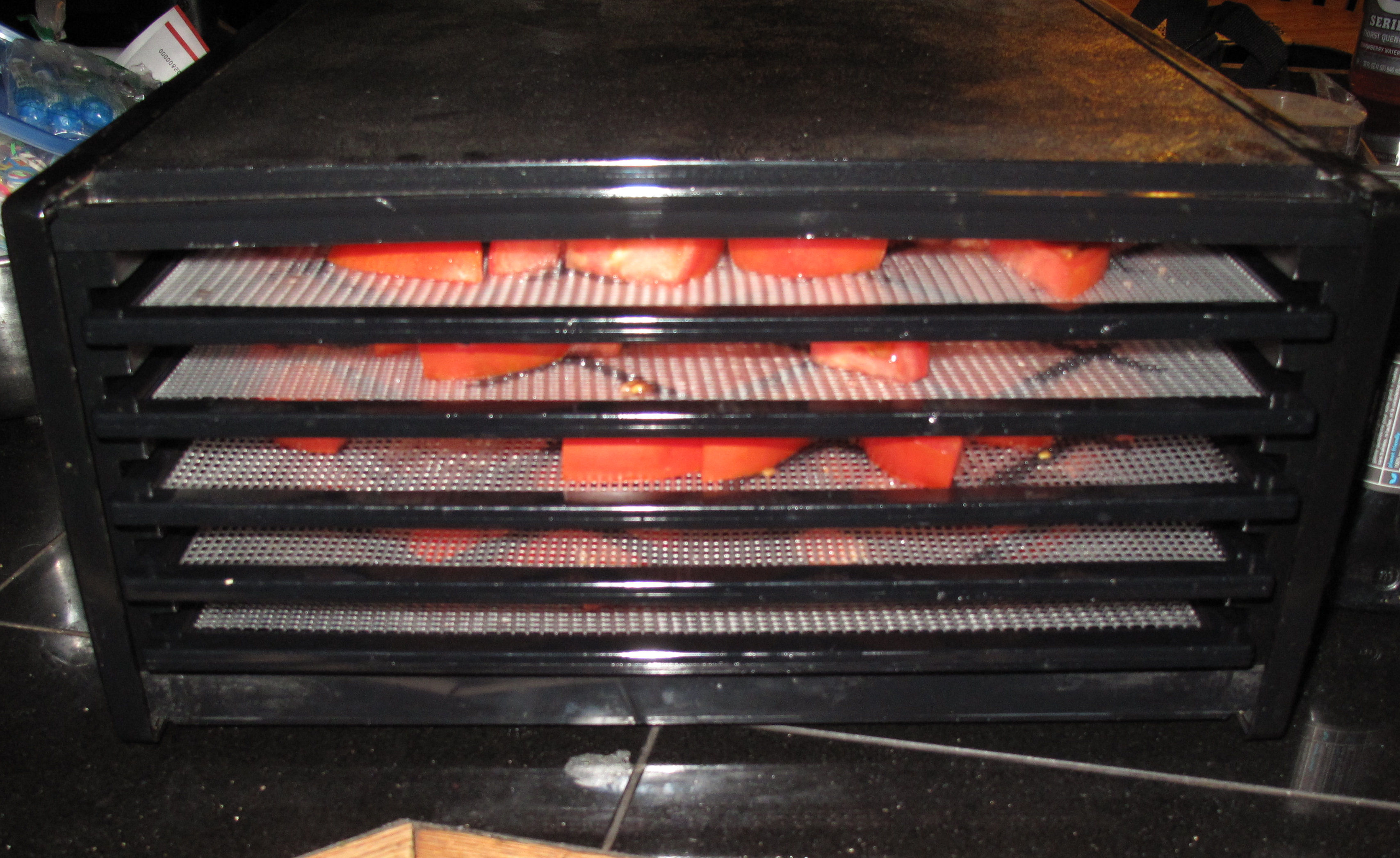
11 lbs of tomatoes took up every inch of the 5 racks I have available to me once diced up in 1 inch by ½ inch cubes/pieces. I layer one rack and then put it in the dehydrator (not running at this point). Keep doing this until you have filled your racks. By the way, I suggest NOT cutting everything up but cutting as you fill the racks, this way you do not have produce leftover that is cut up and no place to put it to dry.

With all 5 FULL (and again, I am breaking the rules, ‘they say’ NOT to allow things to touch, make sure you have enough space around your material that you are drying to allow ‘proper air flow’…ugh…time for the real world please!) and yes, they are close or touching…I put the door onto the dehydrator, set the temperature dial to 125 degrees (which is what is recommended for veggies and yes, I have found this to be ‘right’ otherwise they will ‘burn’) and walk away for the next 12 hours. Did not open the door or check on things until I woke up the next morning and this is what I found….

At this point I did switch the racks around taking the top and bottom racks to the middle rack area and the middle racks to the top/bottom. This does help with the dehydrating process especially if your dehydrator is full like mine was. Put the door back on and walked away again until after dinner (about another 12 hours) and found this…

NOW they are really starting to dry and I simply took my fingers and moved them around flipping them in a general way (not all were flipped…this not an exact science). Walked away until I was ready for bead and came back to the dehydrator. At this point, drying was well on its way and I took two racks out, put them on the counter top and added the remaining racks of the tomatoes still in the dehydrator to the two on the counter top leaving me only TWO racks to put back in, one near the top and one near the bottom. Yes, I combined the racks! With the tomatoes half dried and much smaller than originally started with you can do this and it really helps with finishing up the drying. Racks back in and off to bed I went.

Next morning I was pleased to find that my thickly diced tomatoes were done!

Nice and sweet, ready to cool off. Now that is important to make note of…allow your freshly dehydrated items to thoroughly cool off BEFORE packing, if not, you will wind up with condensation and the resulting mold and spoilage due to moisture!

With 11 lbs of tomatoes I wound up with less than half a quart zip lock baggie of dried diced tomatoes, ready to be sealed up and used at a later date.

It seemed to take a really long time (36 hrs) to dry these tomatoes, but keep in mind times for dehydrating will vary depending up the fruit/veggie used, thickness and humidity in the air (very humid in my house right now with all the rain). So, if you are thinking checking only every 12 is a long time, then check every 4 or 6 if you wish until you get comfortable with the process and learn to trust the process. But keep in the mind, the more you open the dehydrator, the longer it will take.

Enjoy trying out making your own dehydrated tomatoes this year!

The internet is a wonderful thing….I will be the first one to admit it…I like, no let me say, LOVE the internet. Oh the things you can find on it for free! Information, friends, family, like minded individuals…it has revolutionized how people communicate, do business and make connections with others. No more need to go down to the local library to do research, no more hanging out at bars or going out on the town to find ‘that special love’ or make new friends. No more need to drive around town trying to find something that you need. Got someone who doesn’t answer the phone (like me lol!) or ‘never writes’…not a problem…shoot them an email. Networking has become a breeze…MySpace and Facebook, Linked In and don’t forget the dating sites, of which there are now even specialized ones aimed at like minded individuals such a preppers! In the 20 some old years that the internet has become widely available to the general public, it has changed our lives in ways that are so good and used to be unimaginable.

However, there is a darkside to the internet that is rarely discussed or I dare say even thought about…The  Craigslist murders, identity theft, pornography, and the very seeming anonymity of the internet which allows individuals to say and do things that in ‘the real world’ they might never say or do.

Everytime you log into the internet and do a search on a subject, your unique computer address is logged and attached and stored. Google has admitted to ‘red flagging’ and passing along the computer addresses to a certain government agency for certain search terms such as collapse, economic, human to animal, infection, and we can only guess at other terms.  For more information you can check these links out:

http://www.courthousenews.com/2011/12/27/42572.htm

http://www.motherjones.com/politics/2012/04/fbi-twitter-data-mining

Basically, they are doing what is called data mining. They are looking for certain terms to identify potential threats, reasonable enough I suppose on the surface, but then they go ‘surfing’ on social media sites too looking for people and groups that may or may not fit a particular profile of a ‘threat’ such as domestic ‘extremism’ …if you would like to see more on their ‘terms’ you can find them here:

http://www.fas.org/irp/eprint/lexicon.pdf

http://www.dhs.gov/xlibrary/assets/dhs-risk-lexicon-2010.pdf

The above just gives you an overview of what they are looking at in order to identify potential risks…not a big deal on the surface, but if you really read it and do a bit of homework you might, with just a few strokes of the keyboard and posting something on facebook or another online forum get yourself looked at no matter how innocent your comment is.

And if you are a ‘prepper’ well, read the following article…

http://endoftheamericandream.com/archives/preppers-are-now-considered-to-be-potential-terrorists

If I really have your attention now, I dare you to google this phrase:

‘potential indicators of terrorist activities’ and see what you pull up…all kinds of potential indicators from tattoo shops to Costco to motel/hotels…

Okay, now I have covered that end of the darkside of the internet as related to government activities and what they are watching for just a tad bit which is just good knowledge to know…knowledge is power people.

In recent months, there have been cases in the news where people have been charged with crimes from stalking to harassment to extortion (making threats) using the internet and more specifically, facebook or other online forums. Which gets me to the REAL point of this article…the internet is not anonymous, it not ‘secure’, and its not PRIVATE!!! A few angry rants on Facebook or an online forum could be taken the wrong way by someone and then reported to the proper authorities and the next thing you know you got someone knocking at your door and you are looking at some sort of crazy charge simply for venting online or saying something that someone didn’t like. Maybe you have heard of that 15 year old who made a comment about Obama on facebook and wound up answering questions posed to him by the secret service? Or that woman who  was charged with manslaughter of a 15 year for comments made on facebook about the girl (who killed herself by the way), or the ex-boyfriend who ranted on facebook about his ex-girlfriend and almost got himself 5 years in jail…I could go on and on about cases where people have found themselves on the wrong side of the law because of rants and raves left on social media sites and in forums.

Another aspect is that employers are now looking online for YOU and what you say or do, hmm…your private life is no longer private once you post it people and if you post YOUR business online it is not private and they don’t need a search warrant because the internet, social media sites and forums are PUBLIC. That is what you to understand and know and wrap your brain around today. Just because you are sitting in the privacy of your home doesn’t make you anonymous, doesn’t make what you put ‘out there’ private and it is being looked at by who knows who. Criminals, law enforcement, employers, friends, family….if you post it, you own it, you did it, you said it, period…it is not private. And even if you DELETE it, or close the account or erase your computer or whatever, it is still out there somewhere in cyber space…forever….

I don’t say any of this to scare you, but to make you aware to make you think before you type or post a picture. The internet is just like the real world except even more so because anyone can find out what you have said or done with a few strokes of the keyboard, for good or bad purposes. Think before you speak used to be the saying, now it should be think before you type or upload that image…its called using your head and observing OPSEC. It’s not a Polly Anna world anymore and criminals can track you online, the officials can find you easy, or anyone else for that matter, again, for good or bad purposes. Heck, google earth shows your house right online! (which btw you can blur it out so they can’t see your home anymore).

I am not advocating pulling away from the internet, social media or from saying your opinion, but what I am trying to make a point about is to think first and then act. You wouldn’t go down to the local grocery store and post a sign that you are going to be out of town this weekend would you? Then why the heck would you post that for the world to see on Facebook or some online forum? You wouldn’t send pictures of your ‘fun’ weekend to your employer would you? Then why would you post it somewhere online? You wouldn’t make a list of every prep you have with your name, address and phone numbers and make copies and then go stand in the middle of the closest largest city and hand it out would you? They why would you tell everything online? And you certainly wouldn’t handwrite and hand deliver an angry rant about someone or something that happened expressing all your anger and thoughts about what you are thinking about doing (even though you never would) in person…then why the heck would you post something like that online for all to see?

We are all entitled to our opinions and to live our life the way we see fit, by the Constitution we are allowed the pursuit of happiness…but when we put it ‘out there’ (literally) we can open ourselves up to misunderstandings, criminals, predators and set balls in motion unintentionally. We, as Americans do still the right to free speech, but, as has been clarified by the courts, we can’t threaten or harm others with our speech…its one thing to think something and its another to ‘say’ it. Think before you type and upload.

I do believe in the saying, “see something, say something” especially when it comes to the erosion of civil or Constitutional rights or someone breaking the law, tyranny happens when good people ‘see’ but don’t speak up. However, “see something, say something” does not mean that I am allowed to use hate speech, make threats nor harm anyone in reporting what I am saying…think wisely and choose wisely in your words.

I am a big advocate for social networking and sharing ideas and knowledge and opinions, but in the right way, with security and safety kept in mind at all times. The internet is PUBLIC and the internet is FOREVER. Think before you type or upload and keep in mind that not everyone is like you…the internet is a tool, a tool that cuts both ways…lets keep it cutting safely eh? Lets share ideas and knowledge and come together for the common good. Let us share with each other in such a manner that is helpful, not harmful. Let us communicate our thoughts, opinions, knowledge and beliefs with calm, clarity, good intention and forethought. Let us USE the internet to help and support and uplift those that we may come into contact with even unintentionally. Let us not lead ourselves down a slippery slope when using the internet that may find us looking at the wrong end of a gun barrel or open ourselves up to a criminal or predator via the internet. Let us use the internet with safety, security and our future in our minds first and foremost…express yourself and share but be wise.

Prepared people are positive people…let me repeat that…preppers are preparing because they are POSITIVE people. They do not lie to themselves, they see the world for what it is, they have seen the possibilities of ‘danger’ or ‘possible problems’ and have decided to take positive action. Preppers believe this…they can! You CAN! Positive action come from positive thoughts…that something CAN BE DONE and they, in fact are powerful enough to effect change in their own lives. Maybe they can’t change the world in which they live, but they most certainly can change their own lives and have an effect on the outcome of a negative event or situation.

The following I have posted on my Facebook account, under Rev. Laura Bradley and is what inspired this blog:

Positive Thinkers: a reminder from our angels: Positive thinking requires seeing life in a clear light, without lies or pretense. Positive thinkers do not lie to themselves. Often people set out to practice positive thinking, and they end up denying difficulties, disregarding pain, and practicing grandiose wishful thinking. All this is only a form of positive lying. Think about how positive your own thinking is and find ways to strengthen your resolve against the negative, without lies or pretense…you can be positive even while seeing negative and naming it for what it is.

Norman Vincent Peale wrote a groundbreaking book in 1951 entitled ‘The Power of Positive Thinking’ and for the last 55 years, we’ve heard alot about the power that positive thinking brings. Positive thinkers have to be creative and intelligent in their thinking. Positive thinkers look beyond difficulties for creative solutions, seeing the difficulties in a clear light so that clear solutions will surface. On the otherhand, negative thinkers see difficulties in dark hues of hopeless despair and become overwhelmed and defeated by difficulties. We always have the choice to turn the lights on and take a good look at what we are dealing with, and we are always free to assume the best (without lying to ourselves or pretense or pretending).

I have taken this from Angel Wisdom by Terry Lynn Taylor and Mary Beth Crain and have taken the liberty to change a bit 🙂

Hmm…creative? No lying to ourselves? Turning the ‘light’ on? Assuming the best? Don’t deny difficulties or possible difficulties? Finding ways to strength themselves and their resolve against negativity? Gee…that sounds like a prepared person to me…and that is a positive thinker!

I have heard and seen the terms ‘doomers’ but is someone really a doomer? A doomer, by definition, is someone who sees nothing but the negative in this world and does nothing to counteract the negativity or sets about using negative measures to counteract the negative they see in the world…you may know the type and often will hear these sorts of comments: What’s the point? I can’t change anything. What will be will be (as they do nothing to help themselves). I don’t want to know anymore! Someone will come to help us/me if that does happen. And I am sure you can come up with even more statements yourself about doomer thinking or maybe not. Positive thinkers have a hard time thinking like a doomer!

Personally, I wouldn’t bother preparing me and my family against the coming storm(s) if I didn’t believe that we could survive and then thrive afterwards. And that is a positive attitude. To see the potential threat, name it, claim it, own it and then do what I can, where I can, when I can, to get through it as best as possible, so that when the dust settles, me and mine are still standing (hopefully with health intact).

But I will say this, positive thinkers pay attention, see the problem and then take steps to counteract the lies, problems and issues that are inherent in the situation that they are preparing to face, survive and then thrive in spite of. They do not DWELL upon the problem, they get to problem solving. While a positive person may see and name the negative forces or fact (and they certainly seem to be overwhelming at times) they get to problem solving as soon as possible. They may share what they see with others, but then encourage others in the same breath to get to problem solving themselves. If you can’t see the problem, then you are lying to yourself and that goes directly against positive thinking…you can’t ignore or hide or deny the problem exists and be a positive thinker. And you can’t stick your head in the sand assuming that someone else will ‘fix’ the problem for you. Positive thinking requires action of some sort.

Each person who is getting ready ‘for what may come, in whatever form it may come’ sees what they see. Some are aware at higher levels than others, and that is okay. Some of us prepare for literal ‘storms’ such as hurricanes, floods, tornadoes. Some of us take it a step further and have identified other threats that can be from the fragility of our economy (loss of job), to the interconnectedness of our world financial situation, to peak oil, to the erosion of civil and constitutional rights and maybe even identifying that our country cannot continue along as it has with our governments fiscal policies. You name it, we all get prepared for different reasons, but that is okay! It is all identifying a potential negative force in our life, over which we may not be able to effect change at a level to PREVENT the negative influence, so we take steps to mitigate its effects on a personal level. We feel that we have the power to effect positive changes in our own lives to help guard against the negative outside influences that may or may not directly effect us at some time in the future. We are positive in our outlook that we can survive and maybe thrive through what may come in the future.

We are aware, creative and problem solving and learning each and everyday in our preparations for an uncertain future.

We are POSITIVE thinkers, not doom and gloomers. We are just aware and take positive steps for our future while others walk down the road of negative thinking…

Positive thinking requires seeing life in a clear light, without lies or pretense. Positive thinkers do not lie to themselves. Often people set out to practice positive thinking, and they end up denying difficulties, disregarding pain, and practicing grandiose wishful thinking. All this is only a form of positive lying. Think about how positive your own thinking is and find ways to strengthen your resolve and your life against the negative, without lies or pretense…you can be positive even while seeing negative and naming it for what it is.

Positive thinkers have to be creative and intelligent in their thinking. Positive thinkers look beyond difficulties for creative solutions, seeing the difficulties in a clear light so that clear solutions will surface.

On the otherhand, negative thinkers see difficulties in dark hues of hopeless despair and become overwhelmed and defeated by difficulties. They may choose different path ways to overcome ‘difficulties’ but those ways usually involve allowing others to do the work for themselves whether by denial or through directly abdicating their freedom and control over their very lives through dependence.


We always have the choice to turn the lights on and take a good look at what we are dealing with, and we are always free to assume the best…that we can overcome through being prepared…

This is a ‘come over’ from my survivalmedicineblog.com site- sorry for the repeat facebook fans 🙂 but I thought it would bear a reappearance on this one too!

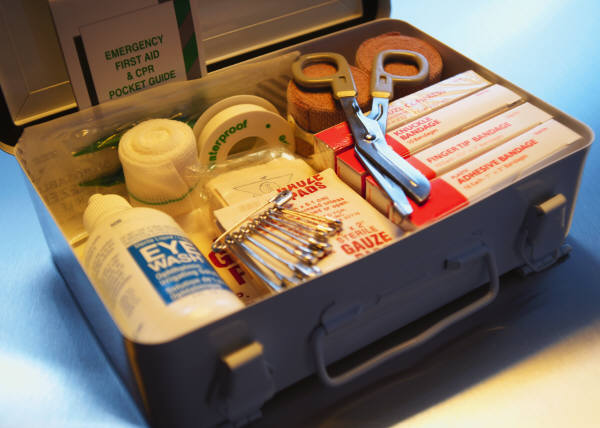
Many preppers and survivalists focus on the beans and bullets aspect of being prepared. They often just say ‘get a good first aid kit’ and call it good. Some go so far as to say get medical equipment and stockpile antibiotics, there are many ideas about what a ‘good’ kit is and list upon lists of what you will need in the event you are ‘forced’ to go it alone in taking care of your own healthcare needs…and then their is the camp that goes so far as to get the training or finds doctors and nurses to include in their ‘group’ But let’s face it, the fact is this: most of us wouldn’t know what the heck to do with most modern medical supplies or medicine or how to propperly use anything beyond a basic bandaid…even if we could our hands on more than the basic band aid and topical cream. Training can be expensive and/or inconvient and hard to come by and sometimes, doing things we have no idea about is more dangerous than doing nothing at all. And most doctors and nurses I know (including my own family) are not preparedness fans let alone self-help types, they rely upon the system and just can’t grasp the idea that being prepared beyond 3-7 days is something worth while. Yes, there are professionals out there who ‘believe’ but again, let’s face it, most don’t.

I am all for having a good first aid kit and modern medical supplies that I am comfortable using, I am also a big one on avoiding doctors and modern medical intervention whenever possible (and my family is FULL of doctors and nurses!)  A lot of my attitude, admittedly, comes from years of not having medical insurance and not exactly being made of money. I was ‘forced’ into finding alternatives in caring for my health needs and just how much I can indeed handle myself.  Over the years, I have become pretty well versed on caring for myself, family and friends and have found that alternatives such as herbalism, homeopathy and essential oils can, when used correctly be just as effective if not more so than modern medicine. I fully recognize that there are limitations to these alternatives and when necessary seek out modern medical intervention, but I have also come to recognize that many of our most basic healthcare needs can be met at home and through the use of alternatives.

There are basic ‘rules of the road’ to taking care of yourself and family that are actually easy to follow if you dare to try it. It’s a mind set mostly, and I hope that you something useful from them that will help you get ready for whatever may come-

Simple rules of the road for taking control of your health needs:

Sanitation/Hygiene– this should be a no-brainer but many infections are spread through bad hygiene habits. Keep your hands clean (either the hand sanitizers or good hand washing with soap and water…and if all else fails, use a baby wipe!) Keep all food handling and prep areas clean. If someone is sick, keep them isolated. I can’t tell you how many times my kids have come home from school sick or I have gotten sick because someone came to school or work sick when they should have stayed home. Make sure you are as clean as possible with your own body and if you get a cut or scrape…clean it asap! Same goes for bites and other wounds…simple, through cleaning of wounds, bites, hands and surfaces goes a long, long way to preventing infections and make sure after helping someone who does have an infection that you wash your hand BEFORE AND AFTER helping them…and by the way…keep your hand out of your mouth, nose and eyes. And for goodness sakes, after using the bathroom or changing a diaper or cleaning up vomit, clean up! Basic stuff folks, but extremely important to prevent infections and disease and in a situation where you are mostly or completely on your own, this ‘simple’ mindset/action could be a life saver.

Be Vigilant and Pay Attention– this is another no-brainer, but I know that many of us get so caught up in what is going on around us that we simply don’t pay attention to our bodies or our children’s behavior (most children will not ‘complain’ or the complaint is very vague). Pay attention to how you feel physically…if you feel warm (without a good reason) or there is pain somewhere, take the time to check it out. If your children are whiny for no reason take the time to find out why. If you child is listless or flushed, take the time to figure out why. If you are tired for no ‘reason’ take the time to figure out why. If there is a little red around a wound or any heat around an area, take the time to take care of it. My point is this, in many instances the body lets you know one way or the other that something is up and the sooner you pay attention to your body and what it is trying to tell you, the better off you will be and the sooner you can do something about it. Time is of the Essence- this goes hand in hand with being vigilant and paying attention…the faster you start doing something about the issue, the less likely it will turn into a life threatening situation. This also goes to preventing things from happening…don’t put off doing what you need to do toady in order to help yourself, from taking care of that cut to fixing that fence or filling up the gas tank…be prepared! Don’t let it go ‘until’, in a SHTF situation, letting it ‘go’ might get you dead…help could be forever in coming, far away or non-existent, so get on it immediately. And one last thing on this subject of being vigilant and paying attention- keep your eye on what is going on around you health wise…lots of coughing? fevers? there might be a time that you being watchful and mindful of your ‘health’ surroundings could save your life (think pandemic) or at the very least, keep you from getting sick yourself.

Have the Knowledge and Experience Beforehand to Help Yourself– it does no good if you stock up on supplies, medicines, herbals, homeopathics and books if you don’t know how to use them, aren’t comfortable using them and don’t know where to find the information in those books that you have spent so much money on when you need it…take the time now to try simple remedies and simple self-medicating/self-help techniques so that you are familiar with them and comfortable in handling a non-emergency situation on your own. After all, if it doesn’t work, you still have plan B…intervention of your doctor (at least for now).  Trying to learn and practice self-help under stressful situations is a disaster waiting to happen. Do it NOW so that you feel confident and sure of yourself…but also note this… Its all well and good to think, ‘well, if the SHTF I will just grow my own medicine’ or ‘I have the book on that! I will be okay!’…many herbal plants need to be grown for several years before they can used. Did you know the best time to harvest? To plant? How to identify them in the wild? Dosage? How to actually use them? Tinctures take 6 weeks or more to make and teas are used for one thing, decoctions for another and tinctures…well, they can be used in a million and one ways…also, will you even try to make your own? Or stock up on pre-made remedies and plants? homeopathic remedies can actually produce symptoms (called a proving) if they are not the correct remedy and some essential oils (just like herbs) can interact with pharmaceuticals, and some essential oils are caustic when used undiluted on the skin or membranes and some oils are best used without dilution…do you know what to do in case an oil gets in your eye or someplace else it doesn’t belong? How to store the herbs, homeopathics and oils? see, you need the knowledge, practice and experience now, before you really need it, so that in a bad situation you are ready to take care of yourself without undue stress. Doctors and nurses trained for years, why not you? Self-care is learned through practice, practice, practice and not just reading about it once.

Be Persistent and Committed! I will be the first to admit that much of the self-help outside of modern medicine is tedious and time consuming and it is definitely not like having to remember to pop a pill once a day and it may not necessary repress symptoms while it is solving the issue at hand. It takes time, effort and a commitment to helping yourself get better without outside intervention in order to make it ‘work’. Often, self-reliance in taking care of your own healthcare matters means doing more than ‘taking’ something. It takes a willingness to take care of yourself and that may mean not doing it all, nor expecting a miracle to happen over night. It may mean that you have to stop what you are doing that seems so important at that moment and doing several things in order to stop a problem before it becomes a problem. Even modern docs now recognize that lifestyle changes, eating habits and exercise patterns are better at preventing many health problems than taking a pill and that just ‘taking’ something often doesn’t ‘cure’ the problem. Be patient, follow instructions to the T, including how much (more is definitely NOT better) and how often to do or take something. Just like most modern medicines that we use today, if not taken correctly it can either harm or not help at all…both of which are not good. Commitment yourself to being self-reliant, learning and being persistent and you will be in good shape for what may come.

Do Not Get Overwhelmed– for many who were raised to be dependant upon the system for their every need in their well-being, it can be scary to break away and become more self-reliant in taking care of their own needs. It can be a daunting task when you first begin to investigate or even begin to take care of yourself and healthcare needs. But by taking it one-step at a time, one thing at a time, one need at a time, and making ‘easy does it’ a part of your mindset you will soon be amazed at just how much you can be in control of your healthcare needs.

Just like most other aspects of being prepared and prepped, you don’t have to do it all at one time and remember, you are not alone…ask for help and make friends who know more than you about it and just do it, make it apart of your preparedness lifestyle and in the end, even if it doesn’t hit the fan and the world suddenly does an about face and everything comes up roses, you will be better for taking control of your own health and well-being.

And lastly, recognize that sometimes you won’t be able to take care of yourself and you might need to ask for help.

PS…if you have a life threatening illness already, by all means necessary, try to stock up on your medication and supplies that you need to take care of yourself…sometimes there is a need for modern medicine…but I also encourage you to do a bit of research and see what else might help you to reduce your dependence upon modern meds. NEVER ever stop taking your medication and switch over to an alternative without the help of your doctor…I love my alternatives but am wise enough to know their limitations.

God bless

Dehydrating Chicken Adventure

Feeling chatty today 🙂 been thinking about food storage alot lately, most especially after my latest trip to the grocery store. Found chicken breast on sale for half-price for the holiday weekend earlier this week so I bought every bit I could with the money I could spend. This was a good thing, but I wound up with over 20 pounds of the stuff and with no more room in either freezer but I had a brilliant idea (yeah, you know the kind, the kind that gets you in so deep that you can only go forward). Dehydrate it! Now, mind you, the dehydrator I have isn’t a fancy one (no temperature control or timer) and I haven’t used it in years…let alone ever used it to dehydrate chicken, but what the heck, I have been reading all over the place about dehydrating meat (and doing it myself is surely cheaper than buying it canned or freeze dried!) and thought perhaps I could do it myself..oh boy…dehydrating 20 lbs of chicken turned into a 4 day odessey of cooking, pressing, cooling, chopping and then watching the bits and pieces of chicken shrink up into tiny pieces over the course of a few hours. My family was looking at me like I was growing heads or had spots all over my face asking such questions like: What are you doing with all that chicken? (I could just hear the groans inside their heads as they saw visions of eatting chicken for the rest of their life) What’s in the pot? Um mom, why are you pressing that chicken in between towels? Then the final questions: are you done yet? what are you going to do with THAT? (referring  to the shriveled up, corn kernal looking things that now sit in 3 quart sized mason jars). Anyway, I digress from my purpose of telling you about dehydrating chicken…it actually turned out to be super easy to do (next on my list is eggs, maybe this weekend, after doing strawberries).

I first embolden myself and reaquainted myself with the process of dehydrating by dehydrating quite a bit of zucchini that my next door neighbor gave me and then tried rehydrating a few pieces just see that it would do so (never mind theory okay? I have to sometimes see it to believe it, just me). And first thing is this…I noticed this SMELL coming from the dehydrator…you know, that smell you smell when you turn on the hair dryer or space heater that you haven’t used in a LONG LONG TIME? yeah, that smell…and then I realized that I would have to play switch the trays around to keep it all drying at about the same rate, and then noticed that the food was sticking to the tray, and I forgot to make sure I had clean mason jars before it got done…you get the idea…but it worked out…growing pains I suppose you could say…next, I did some research trying to find WRITTEN instructions on how to dehydrate chicken online to no avail…sigh…YouTube had some videos on it, but they were long and boring…just TELL ME and let me get on with it okay? but I hung in there, thinking that maybe, just maybe there was some sort of ‘secret’ to dehydrating chicken that I just needed to know…nope…just the basics…keep it clean, cook it well, dry it well and then store it well…and try not to eat it at the sametime you are working with it (have to test the product don’t you?).

Below are the written steps to dehydrating chicken breasts that I was searching for (and if my internet search querry is correct…so are a million others)…I use chicken breasts, not bone-in chicken and that is what the directions are for…I suppose you could use bone-in chicken if you feel like taking the meat off the bones after cooking, but I haven’t done it that way myself…adapt if you must.

and one note: if you don’t want to get sick make sure you wash your hands well everytime before and after handling the chicken…don’t handle the chicken and then touch a spoon or pot or jar or anything like that…safe food handling practices are a must!

You will need:

Chicken, pot, water, seasoning, mason jar(s), oxygen absorbers, dehydrator, knife, towels, baggie, refrigerator.

1. Remove all the fat (if there is any) and skin from the chicken. Fats do not dehydrate nor store long-term very well.

2.Cook your chicken and cook it well…your choice on how you do this, but the idea is that you cook it well until its DONE…err on the side of caution and over cook it if you must. Personally I prefer to just boil it, that way I can add seasoning of my choice while its cooking and it gets in there really well…bonus to this way of cooking it is that you get a really nice broth that can be frozen for future use as a soup base or for replacing water in a receipe if you want more flavor.

3. Let the chicken and broth cool off completely.

4. Get towels (I use bath towels that have been re-purposed for kitchen use) and lay them out on the counter or table top double thickness at least.

5. Put the cooked chicken on the towels. Place another towel over the chicken and then press the HECK out of the chicken. Object being when doing this is to get excess juice out. Shorter drying time.

6. Personally I prefer at this point to stick the chicken into a zip lock baggie and refrigerate over night…makes it easier to cut it up into small pieces…warm chicken is hard to cut up easily.

7. The following day get your dehydrator out. Now, first time I dehydrated I didn’t have the mesh screens to go over the tray. Second time around I did. It will work either way, it is just a bit messier if you don’t have the screens for the trays. Make sure the dehydrator is clean and ready to use.

8. Cut the chicken up into small pieces. I tried a bit of experimenting at this point with different trays, big pieces, small pieces, tiny pieces…the tiny pieces got so small they fell through the cracks, small pieces and big pieces did okay, but use your judgement as to how big of pieces you chop it up into. This will depend upon your drier size since the racks (at least on mine) sit one on top of the other I found the best size for me were pieces about 1 inch long or so no thicker than 1/4 inch. Just chop it!

9. Spread the chopped up chicken around the tray evenly in one layer. Do this for each rack. I found I was able to get about 9 pounds or so onto 5 trays (that is my drier, its one of those round ones with plastic trays that stack up). But I had extra chicken that I just put back into the refrigerator to do later on.

10) Stack it up and turn it on! Now, with my dehydrator I have no temperture control so for me its just turning it on and watching it. If you have a dehydrator with temp control, it is my understanding that you want the temp set at at least 120 degrees for meat, but somehow I don’t think mine got that hot.

11) Walk away and let it go. For me, I had to switch trays around (bottom tray going to the top) every couple of hours to keep things dehydrating somewhat evenly. It took about 10 hours to completely dehydrate the chicken. You want it CRUNCHY and ‘brown’ looking with no softness to it whatsoever. That is moisture and that is NOT good when storing long-term.

*At this point, make sure you have your mason jar (or another glass jar) clean and ready. Also, make sure you have one 200-300 cc oxygen absorber ready for when you need it.*

13) When it is ‘done’ turn off the dehydrator and let the chicken cool off again. Heat will cause condensation which you don’t want in the jar.

14) Once completely cool, you can now fill up the mason jar…fill the jar until you have about 1 inch from the top. Now place one 200-300 cc O2 absorber on top and tightly screw the lid/top on.  Set the jar aside and check to make sure that it has made a seal about an hour later…you check this by pushing on the top…as long as it doesn’t move you are good to go, if it does move, your O2 absorber was probably bad and you need a new one. Repeat.

All done! Now you have your dehydrated chicken that will store for several years and can be used in soups, stir frys and such.

Wasn’t that simple?