

Protein is an invaluable source of long term energy in a survival situation or in any situation in which we are called upon to exert more energy than usual (camping, running, etc.) and/or a time when you can’t really cook or want to keep it simple during and emergency…prepackaged dehydrated food is great if you can find it cheaply, but knowing how to properly dehydrate protein NOW, yourself, before something happens is something to learn how to do and after the initial expense of buying a good dehydrator you will wind up saving yourself tons of money, not mention YOU get to control what goes in your food.
Previously I had dehydrated chicken breasts using one of those smaller, cheaper food dehydrators and honestly, after rehydrating and trying to eat it on the go, I thought that perhaps there could be a better, more flavorful way of doing this.
I wound up buying last year an excellent Excalibur Food dehydrator at a good discount from ebay simply because I was becoming frustrated with the limited amount drying space I had with my old round one. It wasn’t very efficient at drying, the middle ring took forever to dry, with the bottom and top ones drying very quickly and uneven drying on all rings so I was constantly moving the food I was drying around and the large slots meant a lot of food fell through as it was drying…nope…I bit the bullet and bought a good, solid Excalibur and I highly recommend that if you are serious about drying foods for storage or use during camping that you get one…well worth the money!
So here we go again on how to dehydrate chicken, while the first article I wrote on dehydrating chicken is a great and simple start to doing so, I have tweaked my technique and have learned a few tips to add to dehydrating your chicken to make your chicken turn out so much more better.
What you will need:
Dehydrator
Chicken (whatever you can lay your hands on cheaply)
Large pot for boiling your chicken
Powdered Seasonings for infusing flavor into the chicken
One thing I have learned since last writing about dehydrating chicken is that DARK MEAT is the best when dehydrating chicken. When you go to rehydrate or eat it like jerky, it rehydrates much more readily which can be important if you are carrying it with you to eat on the run.
I also like to use thigh or leg meat verses the breast…again, just easier to rehydrate. But use what you have, white meat, thigh, breast, leg, whatever, the process drying is the same. My only note on chicken breast is that it rehydrates more slowly and is tougher after rehydrating (not to mention it COSTS more money unless you can get a real deal on it). And don’t forget you can use bone in or bone out.
So, I found on clearance boneless chicken thighs (mostly dark meat) at the local market…spent maybe $2 for the package. If you are using chicken with bones in it, you will just need to spend the time taking the meat off the bone before putting in the dehydrator.

In one large pot I put 12 cups of water, seasonings to taste (I like to use garlic and onion powder with a touch of salt) and put about 1/3 of cup of each into the water. Then in goes the chicken.
At this point I bring the water, seasonings and chicken to a roiling boil and allow it boil itself until done. You will have to gauge for yourself when it is done cooking as boiling/cooking time will depend upon what you are using. To speed up the process of cooking and if you are using chicken breasts, I have found that by cutting up the breast into chunks FIRST (raw) and then cooking saves time and you don’t over cook the thinner chicken.

When the chicken is done cooking you will then need to do one of two things at this point…if you are using chicken that has a bone in it, you will need to get the meat of the bone place the meat on a plate covered with a couple layers of towels.
If you are using boneless meat you may just place the meat on a plate covered with a couple layers of towels.

FYI: That water you just added spices to and boiled your chicken in? Excellent stock/soup base…don’t throw it away! Extend your money! Can it, freeze it, etc. IF you find yourself without power you have ‘instant’ soup base to rehydrate your chicken in!
Next, you will want to take two more towels, lay them over your meat and press the ‘juice’ out of the meat…this helps to speed up the drying time and keeps the meat from becoming too tough from ‘over dehydrating’ which can easily be done since everything you dehydrate is from the outside in and meat likes to retain its moisture! It wouldn’t to ‘burn’ (over cook so to speak) your meat!
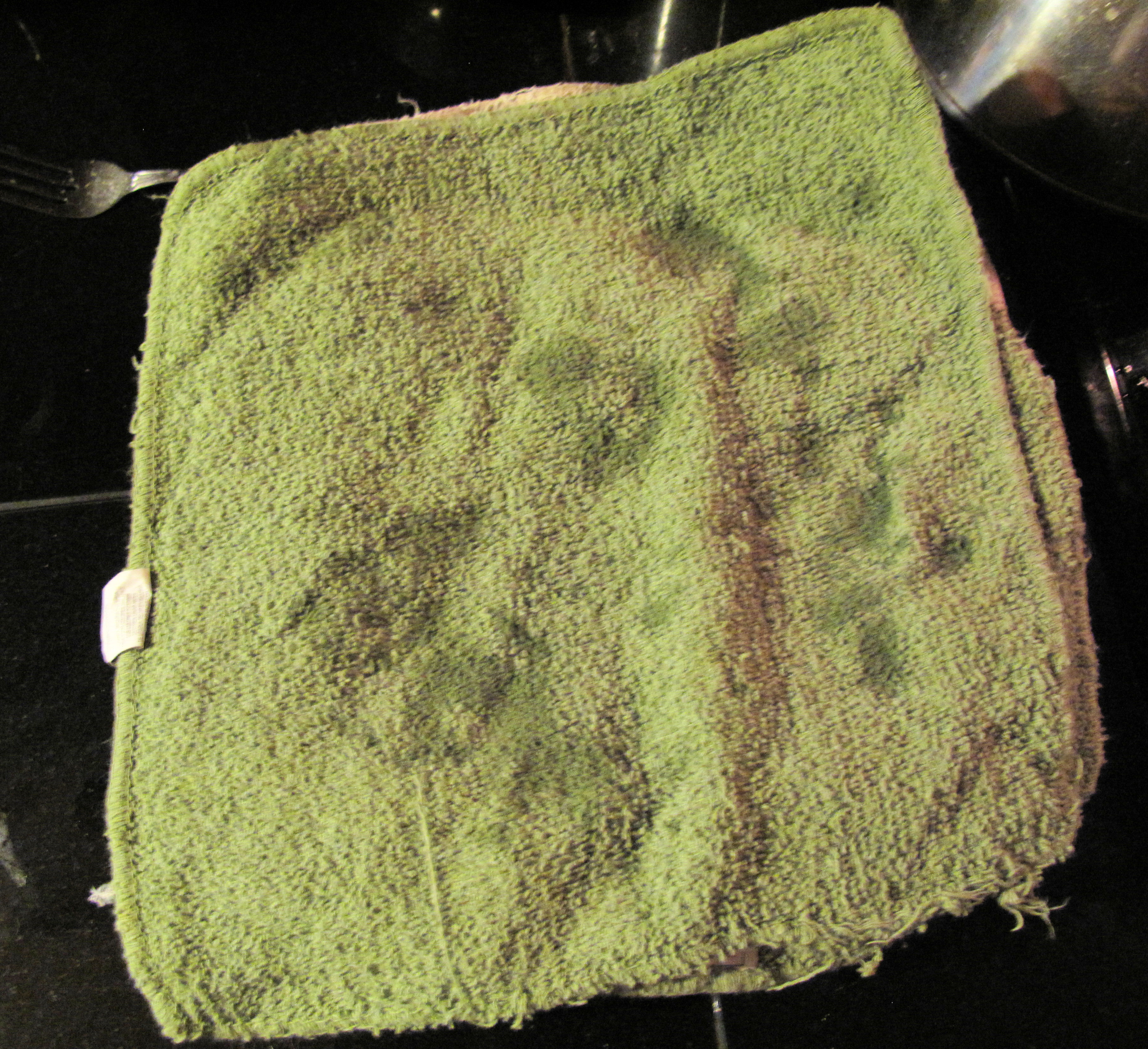
Then allow to cool to room temperature, to speed this up you may place in the refrigerator. I am not sure WHY this helps, but by accident and then by design I have found that this really helps with retaining texture, taste and helps prevent the meat from being tough after rehydration (even with chicken breasts).
After your chicken meat cools off you will need to pull or cut into bite size pieces or whatever size you want. I just like bite size because its faster to dry and easier to rehydrate in your mouth if you want to eat it like that and if using in soups or casseroles you require less water/time to rehydrate (which is important especially if using with noodles or dehydrated veggies which rehydrate faster).
Very lightly spray your trays with an oil (not a lot, just a very, very light coat). This will prevent sticking which is very important if you are using one of the dehydrators that cheaper ones with the big slots. Not so important with an Excalibur as the screen is flexible, but I still spray, makes clean up easier!
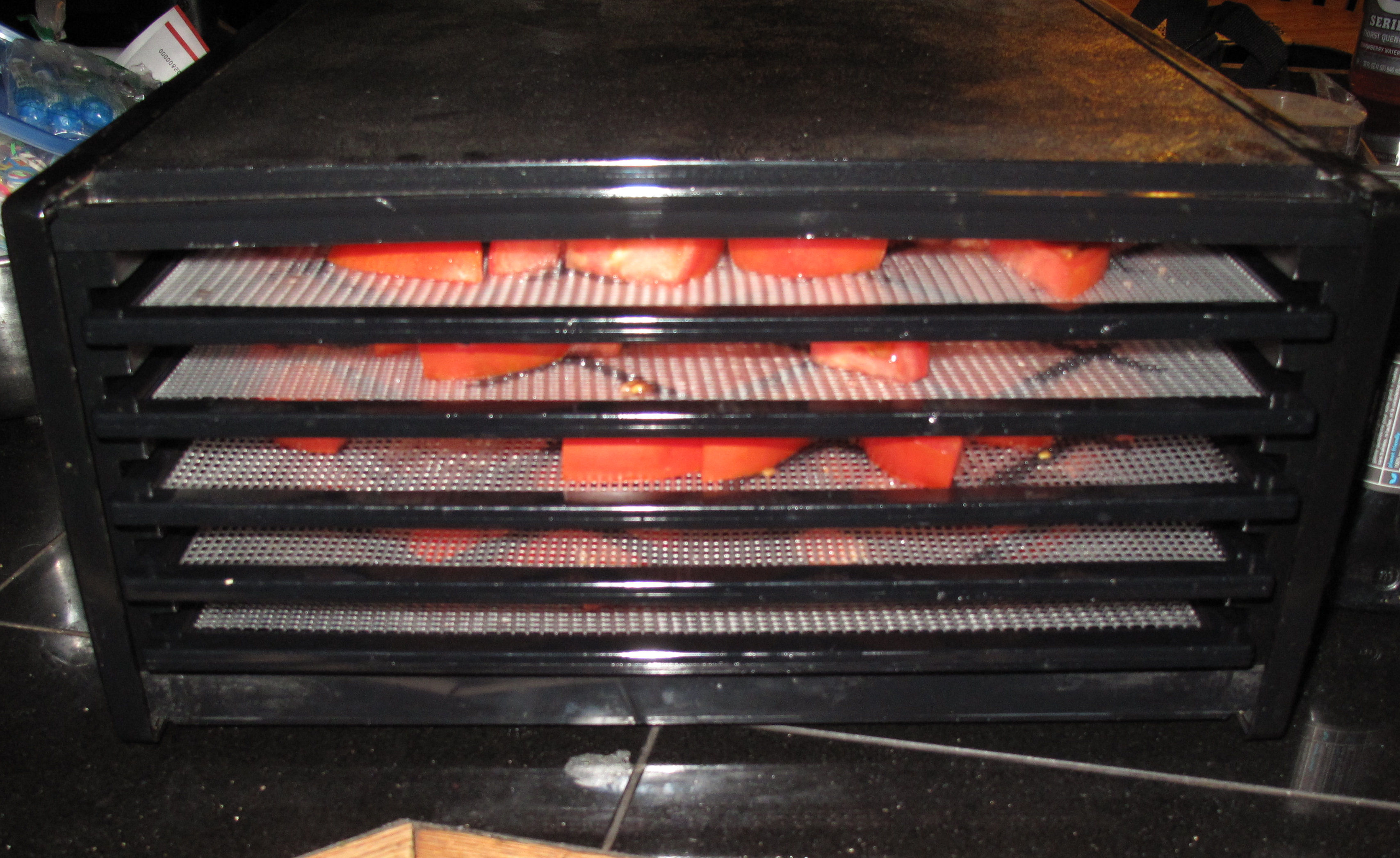
Now you are ready to put your chicken pieces on the drying racks…

At this point, close up your dehydrator…if you have one that allows you to set a temperature on it, you will use 155 degrees temperature setting, if not, just turn it on.
Leave the dehydrator be for at least 3 hours before opening and checking on the chicken. After 3 hours I found mine almost done. You may or may not have the same experience. But if not almost done at this point (and there are many factors that control this) close back up and check again in a couple of hours.
For those with the smaller, cheap dehydrators you may find yourself having to move trays and chicken around to get more even drying. If I am dehydrating A LOT of meat in my Excalibur I wind up moving the racks around once, the top one and bottom one go into the middle and the middle racks go on the top/bottom. But with only 2 racks in I did not have to do this.
IF almost done, shut it down and allow to cool again. I left mine overnight.
The point being is that you will want to shut the dehydrator off when the meat is almost completely dry and allow to cool off.
After cooling off, restart your dehydrator to finish dehydrating. Be careful at this point to check about every half hour so you do not over dehydrate and potentially burn your chicken.
You will know its completely dehydrated when it is no ‘spongy’. I like to ‘sample’ a piece. It will be ‘dry’ and crunchy but easy to chew. Don’t worry if it’s ‘hard’ that happens, but the more you dehydrate meat the better you will get at gauging when its ‘perfect’.

Allow to cool again before packaging by the method you want to do so. If you will be using within the week, ziplock baggies are great…anything longer than a week and you will want to vacuum seal the chicken some how, in a jar or a food saver, though the old timers never did this! For long term storage you will want to remove all the oxygen for best results and longest shelf life. Will store this way for AT LEAST a year, depending upon storage conditions.
Dehydrated properly, chicken (or any meat) is a great way to save money on food storage, make ‘fast food’ meals with little to no mess (one pot! Ever tried cooking after a hurricane? The less ‘pots’ the better!) or it’s a cheap way to make your own camping/bug out food.
My end result:
About 4 cups of protein and weighs in at just over 2 ounces.

To use:
Pretty simple, you can either just munch on it using your own spit to rehydrate it or you can add to water, soups, and so much more! Put together with veggies and noodles in water for a fast meal. Takes about 15 minutes in boiling water to completely rehydrate and heat depending upon the size you make the ‘bites’.




 survivingshtfmom
Built in Redundancy
Hi all! Been away for a while dealing with one of the worst migraines I have had in over a decade…ugh…yuck…they are muscular from stress and lack of sleep and I finally broke down and went to the doctor and am on the mend now, thank goodness.
But as always, this was a learning experience for me…be prepared and don’t rely on one way to take care of yourself and family if TSHTF. Built in redundancy is another way to think about it…either food, medicine, self-defense measures, water or what have you.
Having one way is a good place to start when becoming prepared for what may come, but having a back-up just in case is even better and a ‘last resort’ is the best.
Food wise for me this means a good mix of can goods, MRE’s, freezed dried foods, dry goods and of course, keeping my frig full (not to mention keeping your refrigerator full saves you money because, as counter-intuitive as it may seem, it has to work less as food stays cold longer than air does). Under food I including cooking methods too…electric stove, wood stove, gas grill, gas camping cooker and eventually I want charcoal too and perhaps a solar cooker. And then don’t forget can openers (I have two in the house and 2 stashed away), plates (paper and/or extra regular dishes). Paper/plastic cups are good too.
Medicine– its no secret that I am a practicing herbalist so I have one aspect covered, but I do stock Tylenol, ibuprophen, aspirin, Excedrin, cough syrups (both OTC and herbal) and my own supply of needed pharmaceuticals. I also have a good stock of essential oils and homeopathics. But as I found out this past week, sometimes I will need other types of prescriptions and I am now on the march to find a few more common ones ‘just in case’ all else fails. I have what seems like a zillion and one bandages of all sorts and types, but you know, I have also stocked up on female sanitary pads too as part of ‘medical’…these make GREAT wound absorbers in a pinch.
Self-defense– While I don’t personally know karate or anything like that (though I am not afraid to use my hands if need be) I do have dogs, weapons of various sorts and have been thinking about adding pepper spray to my personal protection plans…but this area also covers escape routes and knowing them (do you know several ways out of your area if need be?) and what about where you frequently shop or go to work? How many ways do you know how to get home from there without using GPS? Knowing the roads around you is important. And what about home security which is ‘self-defense’ also? I can’t maintain OPSEC (operational security) and tell you what I have done personally, but suffice to say things are moving along nicely…some ideas for home security are nice rose bushes under your windows (or even the medicinal plant Oregon Graperoot, which is similar to Goldenseal in its uses), a home security alarm system, motion detector lights, nice tall wooden fences, a gate at the end of your driveway. If you have a large piece of land, barbwire all the way around your property at three different heights could slow someone or something down a bit, high tinsel wire fences that are electrified…the list goes on and on, but the point being is that you use more than one way to protect your home, some seen, some not seen.
Water– having more than one source or way to get water is important too…bottled water, both by the gallon and small drinking water bottles…ways to purify water, chemical, boiling, filtration, and where would you get it? Know at 3 places in your area if possible that you can get water. You can also collect rain water in most areas of the US (check first please, I know some places out west it is illegal to collect rain water). This is a just a basic start to building in redundancy into your preparedness plans, there are other aspects such as ‘money’ or things to barter with, jobs- have multiple sources of income is a good thing, computer files too (how many of you have lost files because your computer crashed? Well, having no electricity is about the samething, what are different ways you can access the information without your main computer? The Kindle accepts PDF files, thumb drives for small laptops, most smart phones take those micro-cards which you can put files onto…and as my recent health issue showed me, I need a few other ‘just in case’ things in case my original plan of taking care of myself doesn’t work.
Things have a way of not working out when you least expect it (which is part of SHFT) and knowing what to do just in case plan A doesn’t work out or runs out having plan B and C will make life easier and give you the breathing room you need…just in case and you never know…it just may save your life.