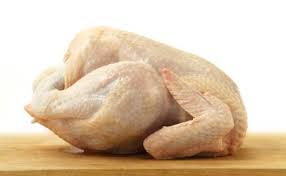
Protein is an invaluable source of long term energy in a survival situation or in any situation in which we are called upon to exert more energy than usual (camping, running, etc.) and/or a time when you can’t really cook or want to keep it simple during and emergency…prepackaged dehydrated food is great if you can find it cheaply, but knowing how to properly dehydrate protein NOW, yourself, before something happens is something to learn how to do and after the initial expense of buying a good dehydrator you will wind up saving yourself tons of money, not mention YOU get to control what goes in your food.
Previously I had dehydrated chicken breasts using one of those smaller, cheaper food dehydrators and honestly, after rehydrating and trying to eat it on the go, I thought that perhaps there could be a better, more flavorful way of doing this.
I wound up buying last year an excellent Excalibur Food dehydrator at a good discount from ebay simply because I was becoming frustrated with the limited amount drying space I had with my old round one. It wasn’t very efficient at drying, the middle ring took forever to dry, with the bottom and top ones drying very quickly and uneven drying on all rings so I was constantly moving the food I was drying around and the large slots meant a lot of food fell through as it was drying…nope…I bit the bullet and bought a good, solid Excalibur and I highly recommend that if you are serious about drying foods for storage or use during camping that you get one…well worth the money!
So here we go again on how to dehydrate chicken, while the first article I wrote on dehydrating chicken is a great and simple start to doing so, I have tweaked my technique and have learned a few tips to add to dehydrating your chicken to make your chicken turn out so much more better.
What you will need:
Dehydrator
Chicken (whatever you can lay your hands on cheaply)
Large pot for boiling your chicken
Powdered Seasonings for infusing flavor into the chicken
One thing I have learned since last writing about dehydrating chicken is that DARK MEAT is the best when dehydrating chicken. When you go to rehydrate or eat it like jerky, it rehydrates much more readily which can be important if you are carrying it with you to eat on the run.
I also like to use thigh or leg meat verses the breast…again, just easier to rehydrate. But use what you have, white meat, thigh, breast, leg, whatever, the process drying is the same. My only note on chicken breast is that it rehydrates more slowly and is tougher after rehydrating (not to mention it COSTS more money unless you can get a real deal on it). And don’t forget you can use bone in or bone out.
So, I found on clearance boneless chicken thighs (mostly dark meat) at the local market…spent maybe $2 for the package. If you are using chicken with bones in it, you will just need to spend the time taking the meat off the bone before putting in the dehydrator.

In one large pot I put 12 cups of water, seasonings to taste (I like to use garlic and onion powder with a touch of salt) and put about 1/3 of cup of each into the water. Then in goes the chicken.
At this point I bring the water, seasonings and chicken to a roiling boil and allow it boil itself until done. You will have to gauge for yourself when it is done cooking as boiling/cooking time will depend upon what you are using. To speed up the process of cooking and if you are using chicken breasts, I have found that by cutting up the breast into chunks FIRST (raw) and then cooking saves time and you don’t over cook the thinner chicken.
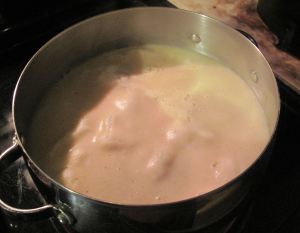
When the chicken is done cooking you will then need to do one of two things at this point…if you are using chicken that has a bone in it, you will need to get the meat of the bone place the meat on a plate covered with a couple layers of towels.
If you are using boneless meat you may just place the meat on a plate covered with a couple layers of towels.
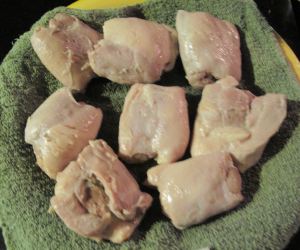
FYI: That water you just added spices to and boiled your chicken in? Excellent stock/soup base…don’t throw it away! Extend your money! Can it, freeze it, etc. IF you find yourself without power you have ‘instant’ soup base to rehydrate your chicken in!
Next, you will want to take two more towels, lay them over your meat and press the ‘juice’ out of the meat…this helps to speed up the drying time and keeps the meat from becoming too tough from ‘over dehydrating’ which can easily be done since everything you dehydrate is from the outside in and meat likes to retain its moisture! It wouldn’t to ‘burn’ (over cook so to speak) your meat!
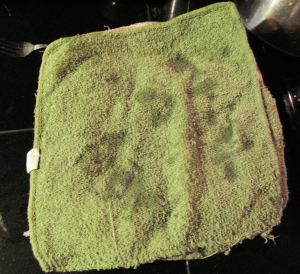
Then allow to cool to room temperature, to speed this up you may place in the refrigerator. I am not sure WHY this helps, but by accident and then by design I have found that this really helps with retaining texture, taste and helps prevent the meat from being tough after rehydration (even with chicken breasts).
After your chicken meat cools off you will need to pull or cut into bite size pieces or whatever size you want. I just like bite size because its faster to dry and easier to rehydrate in your mouth if you want to eat it like that and if using in soups or casseroles you require less water/time to rehydrate (which is important especially if using with noodles or dehydrated veggies which rehydrate faster).
Very lightly spray your trays with an oil (not a lot, just a very, very light coat). This will prevent sticking which is very important if you are using one of the dehydrators that cheaper ones with the big slots. Not so important with an Excalibur as the screen is flexible, but I still spray, makes clean up easier!
Now you are ready to put your chicken pieces on the drying racks…
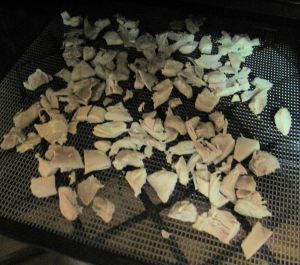
At this point, close up your dehydrator…if you have one that allows you to set a temperature on it, you will use 155 degrees temperature setting, if not, just turn it on.
Leave the dehydrator be for at least 3 hours before opening and checking on the chicken. After 3 hours I found mine almost done. You may or may not have the same experience. But if not almost done at this point (and there are many factors that control this) close back up and check again in a couple of hours.
For those with the smaller, cheap dehydrators you may find yourself having to move trays and chicken around to get more even drying. If I am dehydrating A LOT of meat in my Excalibur I wind up moving the racks around once, the top one and bottom one go into the middle and the middle racks go on the top/bottom. But with only 2 racks in I did not have to do this.
IF almost done, shut it down and allow to cool again. I left mine overnight.
The point being is that you will want to shut the dehydrator off when the meat is almost completely dry and allow to cool off.
After cooling off, restart your dehydrator to finish dehydrating. Be careful at this point to check about every half hour so you do not over dehydrate and potentially burn your chicken.
You will know its completely dehydrated when it is no ‘spongy’. I like to ‘sample’ a piece. It will be ‘dry’ and crunchy but easy to chew. Don’t worry if it’s ‘hard’ that happens, but the more you dehydrate meat the better you will get at gauging when its ‘perfect’.
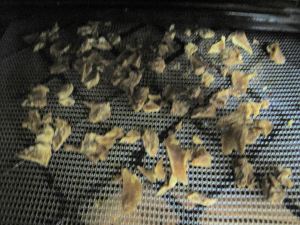
Allow to cool again before packaging by the method you want to do so. If you will be using within the week, ziplock baggies are great…anything longer than a week and you will want to vacuum seal the chicken some how, in a jar or a food saver, though the old timers never did this! For long term storage you will want to remove all the oxygen for best results and longest shelf life. Will store this way for AT LEAST a year, depending upon storage conditions.
Dehydrated properly, chicken (or any meat) is a great way to save money on food storage, make ‘fast food’ meals with little to no mess (one pot! Ever tried cooking after a hurricane? The less ‘pots’ the better!) or it’s a cheap way to make your own camping/bug out food.
My end result:
About 4 cups of protein and weighs in at just over 2 ounces.
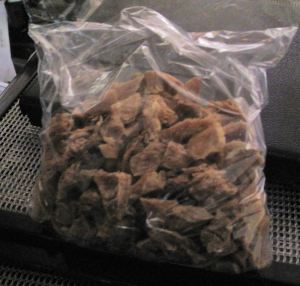
To use:
Pretty simple, you can either just munch on it using your own spit to rehydrate it or you can add to water, soups, and so much more! Put together with veggies and noodles in water for a fast meal. Takes about 15 minutes in boiling water to completely rehydrate and heat depending upon the size you make the ‘bites’.







 survivingshtfmom
Hunting, Fishing, Gardening and Foraging as Survival Tool
Surviving off the land…fact or fiction?…do you believe, that in the event of an emergency situation that you could simply go out into the woods and survive? Or that in order to get food on the table that you will take that old .22 and go kill some meat in the woods or that simply dropping a fishing hook in the water everyday that you and yours could live? That foraging alone in the woods and fields will get you what you need on a daily basis? That all you have to do is throw some seeds out there and presto, within weeks you will have an abundant selection of veggies to eat daily? This is a myth…and the golden hordes (read that city dwellers) that may or may not come out if and when the supply chain or money dries up don’t know it is a myth.
Dream on and don’t come knocking on my door when you figure out that its all a lot harder than you thought it would be and you are starving because you failed to ‘get’ the fact that subsistence living or living ‘survival’ style in the woods just won’t get it no matter what the ‘professionals’ say. Remember that word ‘professional’ and what that means, it means THEY DO WHAT THEY DO FOR A LIVING AND DO IT WELL AND REGULARLY!!! And they always have back up…which you don’t see…just in case (hmm, 3 is 2, 2 is 1 and 1 is none).
Fact is that hunting, fishing, gardening and foraging are all SKILLS that must be developed and even then, it is HARD WORK that takes a lot time. And even if you have the skills do any hunting, fishing, foraging or gardening, there are no promises at the beginning or end of the day that you will get what you need for that day, let alone for future days when you get nothing on a particular day.
Case in point, I have for a few years tried my hand at gardening. All the knowledge in the world doesn’t mean diddly when it doesn’t ran or rains too much…or frost comes early or you get an attack of bugs (or critters!) that kills your plants or eats your hard won fruits and veggies before you can get to them. Have had it all happen plus other interesting things…such as some veggies and fruits just won’t grow on my property despite how much work I put into them. Some methods of gardening just don’t work in my area. It is has been and is still a process of learning my own land and area that has led to some successes and a lot of failures that teach me what not to do and sends me back to the drawing board to try something else/different the following year.
Another case in point that I have recently learned….hunting and fishing are hard work and frankly, start up costs are EXPENSIVE. Now you could argue that you don’t ‘need’ a lot to get going with either and I would agree with you, but you need the basics…A fishing pole, bait and that’s all right? Hmm, well, if you think so…depends on what you are after and if you are innately talented at fishing to get by with just any old fishing pole and bait. How are you gonna clean it? Do you know how to use that pole? Or even tie a fishing hook onto the pole? Yeah…are you getting the idea now? And by the way, there is skill involved, tricks to the trade if you will…last time I went fishing (see the bluegill video) my friend caught 5 in minutes and me, well, lets just say that once I could get a cast off those little suckers ATE THE BAIT and I got nothing.
Now we can go onto hunting…where do I start there. I was kinda one of those persons until recently that thought all you did was get the rifle and go out. First off, you better be able to hit what you are aiming at…so do you know your ‘weapon’? are you good with it? Because the last thing you want to do is take a shot and spook dinner down the hill or forbid this from happening, you don’t make a clean kill and the thing runs off and dies somewhere and you either don’t find it or have to go miles trying to track it (do you know how to do that?). Did you know that an animals senses are super sensitive? The can, in general see us, hear us and smell us long before we see or hear them. So can you sit still? Walk quietly in the woods? Do you know how to blend in smell wise or better yet, NOT SMELL? (try that one when you haven’t had a bath in days and its 90 degrees outside). Okay, now, do you know how to get up in a tree? Trust me when I tell you that if you think a climbing tree stand is EASY to use you got another thing coming and from what I am told, hunting from the ground is iffy at best, though doable if you can hide yourself well enough. Good luck sneaking up on a deer or rabbit or even a squirrel. Can you find a trail or the signs that an animal is a frequent visitor? If you can’t then you are relying on luck and stupidity of an animal that is used to being hunted one way or another. And lets not forget that there are most certainly others out there looking for the samething as you are.
I have spent the time, effort and energy to get my self set with gear for hunting and fishing. Archery season just started last weekend…I got the bruises and weary muscles to prove that I now know how to use a climbing tree stand. So up I went last Saturday after getting up at 4:30 am to get to a spot that my friend, who has hunted for years picked out for me beforehand. And I will tell you that just GETTING to that tree that I had to climb was interesting (lesson learned: make sure all gear is secure on the body otherwise you will be chasing it in the dark). Then up the tree I went right around dawn, get settled, get the gear up to me (do you know how to safely do that???) and there I sat, watching, waiting, just sure a deer or turkey would come through…okay, next thing is this, its hard to stay alert when you can’t move. Think I nodded off a couple of times. Then after a few hours of sitting in my ‘perfect’ spot I hear some people further down the trail yelling and then a dog barking, not to mention it was getting hot. (Did I forget to mention did you think about what you were going to do when nature called?? Haha! Yeah…) I sat there so long and still enough that the squirrels were paying me absolutely no mind. And those things are sensitive suckers (never did get one earlier in the season, but there they were this time, lots of them!). I could go on and on and on, but long and short of this story is that hunting IS NOT WHAT YOU READ ABOUT OR SEE ON TV. Its hard and iffy in good times, now imagine that if a good hunter can’t get a kill during the good times (such as my friends that I went with last weekend) then what will it be like when you are hungry, tired and stressed out to the max? Back to the drawing board and practice more and cross my fingers that next time providence is on my side. Oh, by the way, do you know how to clean that animal and field dress it? I think you get my point…And I will tell you this, when it hits the fan I am NOT stepping out into the woods for a few weeks, I want to live and with a lot of people thinking they will just go out and kill to eat all I can foresee is a lot of accidents happening and none of them ending well. Every year people are killed and maimed hunting by accident and this happens in the ‘good times’.
Lastly, foraging…forget depending upon it for long term survival. It’s a good fill in IF you know what you are looking for (and you had better be good at plant identification unless you want to get sick or die) and can then find it…but it is what it is…foraging for survival and again, it is a skill and takes time, practice and knowledge…if you think that just having a few books on hand will get you what and need without actually going out there and doing it…good luck…And did I mention that you will be out there with the critters competing for the same food?
There is a reason why humans gathered into groups and began establishing formalized agriculture and animal husbandry (raising animals). It created conditions in which civilization could be established and more reliable food sources. But even then, things happen and fail (look at the hippies for confirmation of this). Can you imagine the hundreds of people who ‘think they can’ only to finally conclude that they can’t? Then what? Failure happens more often that success, remember that.
I am not trying to be a Debbie Downer, but what I am doing is trying to point out some basic facts, that IF YOU FAIL to do something now, learn how to do something NOW and PRACTICE that NOW you will not just be able to go out and ‘do it’ and in fact, you may just get yourself killed in the process since you will be under stress and most likely tired and low on energy and most likely there will ALOT of others ‘trying’ to do the same thing, in the same place, at the same time as you are (and I won’t tell you the stories about idiots who will shoot at a noise in bushes…hmm…is that the bush you are picking berries from?)
And that brings up one last skill that we as a collective have laid by the wayside…situational awareness…basically that means you know what is going on around you and are alert to potential dangers and CONSCIOUS enough to identify them and take the appropriate action, at the appropriate time.
Instead of playing video games or going to the mall, start to practice growing a garden…go find someone who can hunt or fish and partner up with them to learn how to do this NOW. Do you really need that new iPhone? Or a ‘new’ car? Or that extra night out eating? Invest your money in the best equipment you can afford now or trade for it. Take the time to go out and actually do what you think will help you in the future to get by during the hard times. The learning curve is steep people, because trust me, its not as easy as you think and even those with the can do, do or die attitude will fail at some point in time. Learn skills now while you can, when it doesn’t count so much and when the time comes, you will have the advantage.